
A reference for listing agents and buyer’s agents
Chimney inspections for real estate
A chimney problem found during a sale can change the repair budget and the closing timeline. This page is a reference for real estate agents: what to ask before a listing goes live or before repairs are negotiated, how a chimney inspection differs from a general home inspection, and what common findings mean. It is an educational reference, not an installation guide and not an offer of services.
Action list before listing
- Ask whether the fireplace or chimney flue has ever been camera-inspected, and keep any report with the listing file.
- Do not treat a prior general home inspection as proof that the flue interior was checked, or that the lining meets current expectations for the intended use.
- Ask a chimney professional to identify the liner and document its condition. A sound-looking exterior does not establish the condition of the interior.
- If lining or other major repair may be needed, ask for written findings, a written scope of work, what permits may be required, and how unknowns found once work begins will be handled — before a price reduction or repair credit is finalized.
- Pay attention to weather damage at the top of the stack. A cracked or missing crown, a damaged cap, or open mortar joints can let water into the flue tiles and the masonry. Those items are described under common findings, below.
- For lining, code basics, inspection levels, and labeled parts of each common system, use the sections on this page and the system pages on this site.
What agents often do not realize
Oregon certified home inspectors observe chimneys, flues, and vents where those parts are readily visible. They are not required to observe the interior of flues or fireplace-insert flue connections (OAR 812-008-0210). They are also not required to report whether a property complies with codes, ordinances, statutes, or other regulatory requirements (OAR 812-008-0204). A quiet past home-inspection report can still leave the lining, and the condition of the flue, unanswered.
Around a sale or transfer, chimney professionals commonly use a deeper inspection — in NFPA 211, a Level II inspection — that includes camera or video examination of the flue interior where that is possible. NFPA 211, section 15.4.1, provides that a Level II inspection shall be conducted upon sale or transfer of the property. That is a requirement of the standard. It is not, by itself, a statewide Oregon legal mandate that every sale include a Level II inspection. Confirm what the parties want to order and what the local market expects.
Lined does not mean stainless-steel only. Clay flue tiles that comply with ASTM C315 are a recognized lining. Listed metal lining systems (for example, systems listed to UL 1777) are a common retrofit when clay lining cannot be restored. The lining has to be appropriate for the connected appliance. A neat brick exterior or a new rain cap does not prove that the interior passage is continuous, correctly sized, or suitable for the appliance that is connected to it.
Questions buyer’s agents should ask
- Was the flue video-scanned, or only viewed from accessible openings such as the firebox, a cleanout, or the top?
- Is the flue lined — with clay tiles, a listed metal system, or neither — and how was that determined?
- If work is recommended, does the written scope include the firebox, the smoke chamber, or crown reconstruction, and what remains unknown until the system is opened?
- Will a permit be part of the path, and who will coordinate with the building department?
- Relining can involve more than inserting a liner. Firebox or smoke-chamber access, crown work, and related masonry are possible on some homes. Hidden conditions may expand the scope once work begins. Ask how new findings would affect the written scope, the budget, and the timing. That expansion is not certain on every job.
- Costs depend on what is found. This page does not quote prices.
Questions to ask the sellers
- When was the chimney last swept or inspected, and is there a written report?
- Are the appliance manuals and listing information available?
- Was a permit obtained for a stove, an insert, a liner, or other chimney work, and was that work inspected?
- What fuel is used — wood, gas, pellets, more than one fuel, or is the system unused?
- Has there been a chimney fire, weather or seismic damage, or earlier repair, and is that work documented?
NFPA 211 inspection levels
NFPA 211, the Standard for Chimneys, Fireplaces, Vents, and Solid Fuel–Burning Appliances, describes three levels of inspection of an existing chimney. The type of inspection is based on the circumstances that give rise to it. Nothing in the standard prevents a more thorough inspection than the minimum for those circumstances.
-
Level I
Used when the need is to verify that the chimney or flue is suitable for continued service under the same conditions, with the same or a similar appliance. NFPA 211 calls for a Level I inspection during the annual inspection, during routine cleaning of a flue, and when a connected appliance is replaced with an equal number of appliances of similar type, input rating, and efficiency.
The inspection covers readily accessible portions of the chimney and accessible portions of the connected appliance and the chimney connector. Readily accessible flue areas that can be seen through existing openings — a thimble, a cleanout, or the flue termination — are examined. It does not require removal of building finishes, and it does not, by itself, require a video scan of the entire flue.
-
Level II
Indicated when the chimney’s suitability for new or changed conditions of service needs to be verified, or when a Level I inspection is not sufficient to determine serviceability. A Level II inspection shall be conducted upon addition or removal of a connected appliance, or replacement with an appliance of dissimilar type, input rating, or efficiency; prior to relining or replacement of flue lining; upon sale or transfer of the property; and after a building or chimney fire, a weather or seismic event, or another incident likely to have caused damage to the chimney.
A Level II inspection includes the Level I items, plus all areas of the chimney and its surroundings that can be reached without removing or destroying permanently attached portions of the chimney or the building — including accessible attics, crawl spaces, and basements. It includes examination of accessible areas of the flues and the internal surfaces of the flue liners with video scanning equipment or other means as needed to observe those areas, a check of accessible clearances to combustibles, and an evaluation of whether the lining type and the flue size are proper for the connected appliances.
-
Level III
Used for concealed areas. A Level III inspection is required only for those areas that are suspected of malfunction or damage and that cannot be properly evaluated by a Level I or Level II inspection. Circumstances include investigation of a fire, weather or seismic event, or other incident known to have caused damage, and a hazard found or suspected in a Level I or Level II inspection that cannot be fully evaluated without access to concealed areas.
The inspection includes the Level I and Level II items, plus concealed areas that can be reached only by removal or destruction of permanently attached portions of the chimney or the building structure, as necessary to determine compliance with the standard. It is not a routine listing inspection.
CSIA’s Level 2 masonry-chimney procedure is an industry resource that walks through a Level II inspection and describes a Level 2 inspection as recommended when a property is being sold. The wording of NFPA 211 itself is that a Level II inspection shall be conducted upon sale or transfer. As noted above, that is a requirement of the standard, not automatically a statewide Oregon legal mandate for every sale.
How a chimney inspection differs from a general home inspection
A general home inspection remains useful, and Oregon’s standards require the certified home inspector to observe chimneys, flues, and vents where they are readily visible, and to observe solid-fuel heating devices (OAR 812-008-0210). The same rule says the inspector is not required to observe the interior of flues or fireplace-insert flue connections, and is not required to ignite or extinguish solid-fuel fires. OAR 812-008-0204 says the inspector is not required to report compliance or non-compliance with codes, ordinances, statutes, or regulatory requirements, and is not required to report methods, materials, or costs of corrections.
A Level II chimney inspection is aimed at those gaps: the interior of the flue, the type and condition of the lining, accessible clearances, and whether the flue is appropriate for the connected appliance. A general home inspection is not a substitute for a camera inspection of the flue or for a written chimney report prepared at that level.
Common findings and what they mean
The items below are conditions that often show up in inspection reports. Each one has to be judged on the actual observations, the adopted code, and — for a listed appliance — the manufacturer’s manual. This is not a complete list, and it is not a diagnosis of any particular house.
- Missing or cracked crown
- The 2024 IRC, as adopted in the 2026 Oregon Residential Specialty Code, requires masonry chimneys to have a concrete, metal, or stone cap, sloped to shed water, with a drip edge and a caulked bond break around any flue liners (R1003.9.1, ASTM C1283). A cracked, missing, or poorly sloped crown is a common path for water into the masonry and the flue.
- No cap, or a damaged cap
- Agents often use “cap” for the metal rain cap or spark arrestor at the flue outlet, which is separate from the masonry crown. Where a rain cap is installed, the net free area under it must be not less than four times the net free area of the flue outlet (R1003.9.3). A damaged or missing cap can let in rain, debris, and animals. On Oregon forest-zoned land, each chimney is required to have a spark arrestor (ORS 215.730); where a spark arrestor is installed, it must also meet R1003.9.2.
- Deteriorated mortar joints
- Open or eroded mortar can let water into the chimney. In serious cases it can affect the soundness of the masonry. NFPA 211, section 14.2, requires chimneys, fireplaces, and vents to be inspected at least once a year for soundness, freedom from deposits, and correct clearances, with cleaning, maintenance, and repairs done if necessary.
- Cracked or missing flue tiles
- Clay flue tiles are a recognized lining when they comply with ASTM C315 and are properly installed (R1003.11.1, R1003.12). Cracks, missing tiles, or open joints can let heat and combustion products reach the surrounding masonry, and they can also leak water. A camera inspection is the usual way to document the interior of the tiles. A sound exterior does not prove the tiles are intact.
- Unlined or improperly lined flue
- Masonry chimneys shall be lined, and the lining material shall be appropriate for the type of appliance connected, in accordance with the appliance listing and the manufacturer’s instructions (R1003.11). An unlined flue, a lining that is damaged, or a lining that is the wrong type or size for the connected appliance is a central finding in a Level II inspection. Listed metal systems and factory-built chimney units listed for installation in masonry chimneys are accepted alternatives to clay tile when they are installed to their listing.
- Creosote deposits
- Creosote and soot are combustible deposits from wood burning. NFPA 211 requires inspection for freedom from deposits and cleaning when needed. CSIA follows that standard and recommends that masonry fireplaces be swept at 1/8 inch of sooty buildup, and sooner if any glaze (creosote) is present. Factory-built fireplaces should be swept when any appreciable buildup occurs, because the deposits are acidic and can corrode those systems. Sweeps often describe deposits in three stages: flaky soot that brushes off; denser, crunchy or tar-like buildup; and a hard or gummy glazed coating. Glazed deposits often cannot be removed by ordinary brushing and may need professional chemical treatment plus mechanical cleaning. CSIA states that chemical cleaners alone are not a substitute for inspection and mechanical cleaning.
- Water damage
- Water that enters through a failed crown, damaged flashing, a missing cricket, or open mortar joints can stain interiors, deteriorate masonry, damage flue tiles, and corrode metal parts. The presence of rust, staining, or spalled brick is a reason to look at how water is being shed at the top of the stack and at the roof intersection, not only at the stained surface.
- Missing cricket
- A cricket or saddle is required on the ridge side of a chimney or penetration more than 30 inches wide, measured perpendicular to the slope (R903.2.2). For masonry chimneys, a cricket is also required where the dimension parallel to the ridgeline is greater than 30 inches and the chimney does not intersect the ridgeline, with flashing and counterflashing at the intersection (R1003.20). A missing cricket on a chimney that meets those thresholds can leave a pocket where water and debris collect.
- Clearance-to-combustibles problems
- Code sets minimum clearances from masonry fireplaces and chimneys to combustible framing, trim, and mantels (R1001.11, R1003.18), and listed appliances and factory-built chimneys must maintain the clearances in their listing and installation manual. A Level II inspection includes verification of proper clearances at locations that can be accessed without removing building finishes. Combustible material that is too close to a flue, a connector, or an appliance is a fire concern and may require correction before the system is used.
- A damper problem
- Masonry fireplaces are required to have a ferrous-metal damper, located not less than 8 inches above the top of the fireplace opening, installed in the fireplace or in the chimney that vents it, and operable from the room (R1001.7.1). A damper that will not open or close, is missing, or is blocked affects both safety and weather-sealing. CSIA notes that a fire lit against a closed damper can fill a room with smoke and can be a fire hazard.
- An unlisted or unpermitted stove or insert
- Factory-built fireplaces and factory-built chimneys shall be listed and labeled and installed in accordance with their listing (R1004.1, R1005.1). Listed wood stoves and inserts must be installed to the manufacturer’s instructions and listing. A unit that is unlisted, or a listed unit that was not installed to its listing, may not be acceptable to a building official. Ask whether a permit was obtained and whether the installation was inspected. Permit rules are set by the local building department.
- A gas appliance that has not been inspected or serviced
- Gas often burns more cleanly than wood, but the chimney can still be blocked by nests or debris, and a flue that was sized for an older appliance may not suit a newer one. CSIA states that chimneys serving gas appliances should be included in annual inspections. NFPA 211’s annual inspection of chimneys, fireplaces, and vents applies to those systems as well. Gas appliances also have to be installed and maintained in accordance with the manufacturer’s instructions and the fuel-gas code (NFPA 54 and IRC Chapter 24). Ask when the appliance was last inspected or serviced, and whether the venting was part of that work. This page does not set a service price or a specific service interval beyond the sources above.
What belongs in a useful inspection report
- The level of inspection that was performed (I, II, or III), and the date.
- Photographs of relevant exterior and appliance conditions, and camera or video footage of the flue interior when a Level II or Level III inspection is performed. NFPA 211, section 15.4.2.3, requires examination of accessible flue and liner surfaces with video scanning equipment or other means as needed to observe those areas.
- Identification of the lining — clay, a listed metal system, or none — and whether that lining is appropriate for the connected appliance, tied to the adopted code or to the appliance listing and manual where those apply.
- A statement of what was and was not accessible. If circumstances prevent completion of the level that was indicated or requested, NFPA 211, section 15.2.6, requires the inspector to indicate the level that was completed and to document why the higher level was not completed.
- Findings described clearly enough that a listing agent, a buyer’s agent, or a building official can see what was observed, how serious the inspector considers each item, and what is recommended — including whether a higher level of inspection, a repair, or a permit path is recommended. There is no single mandated severity scale in the sources cited here; a useful report still distinguishes conditions that affect safe use now from items to repair or to monitor.
- If work is recommended, a written scope, what cannot be known until the system is opened, and whether a permit is expected — so that a credit or a price reduction is not locked in on incomplete information.
Timing around inspection contingencies
In a typical sale, the purchase agreement sets an inspection period. The length of that period is negotiated by the parties; this page does not assign a number of days. A chimney specialist visit, a written report, and any repair estimates can take time to schedule and to review. It is useful to start that work early enough that findings can be considered before the contingency expires.
If lining or masonry work may be needed, written findings, a written scope, permit expectations, and the handling of unknowns should be requested before a repair credit or a price reduction is finalized. A camera inspection arranged before the home is listed can reduce the chance that those questions first appear in the middle of a short contingency window.
System pages on this site
Each page has a labeled cross-section, a plain-English glossary, and a list of items to verify against the current code or the appliance’s listing. The masonry page also has a table of current Oregon code clearances and dimensions.
-
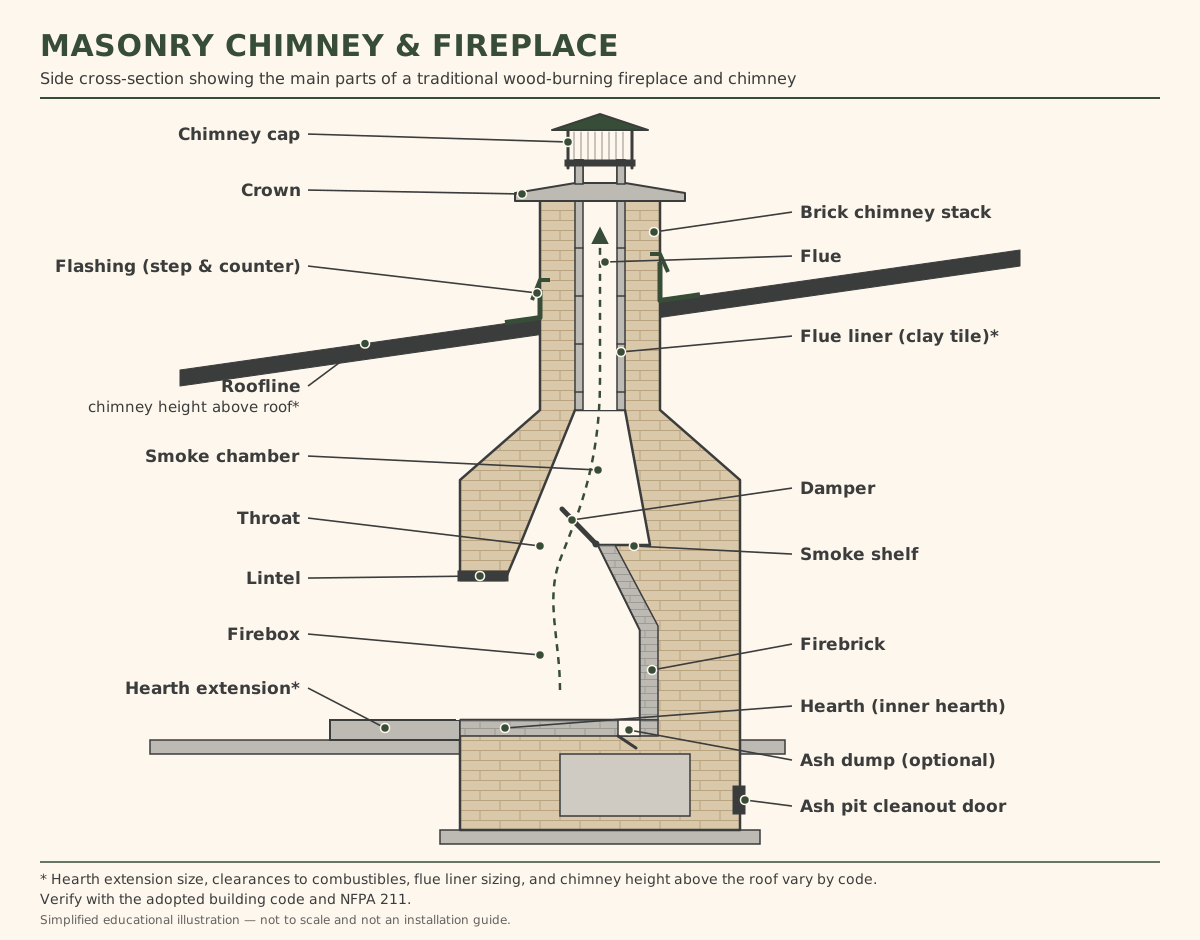
Masonry Chimney & Fireplace
A site-built wood-burning fireplace and brick chimney, shown in side cross-section.
-
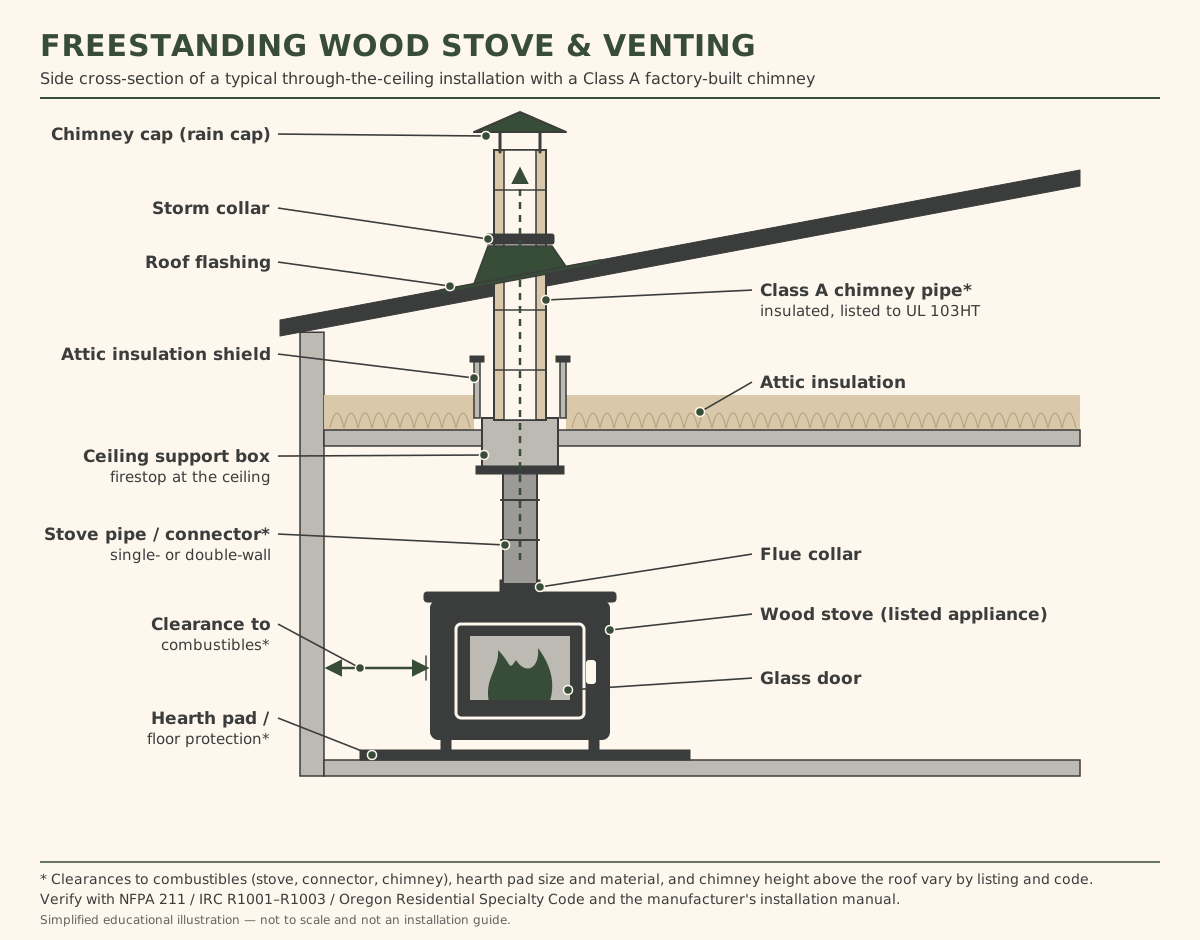
Freestanding Wood Stove & Venting
A freestanding wood stove vented through a factory-built Class A chimney.
-
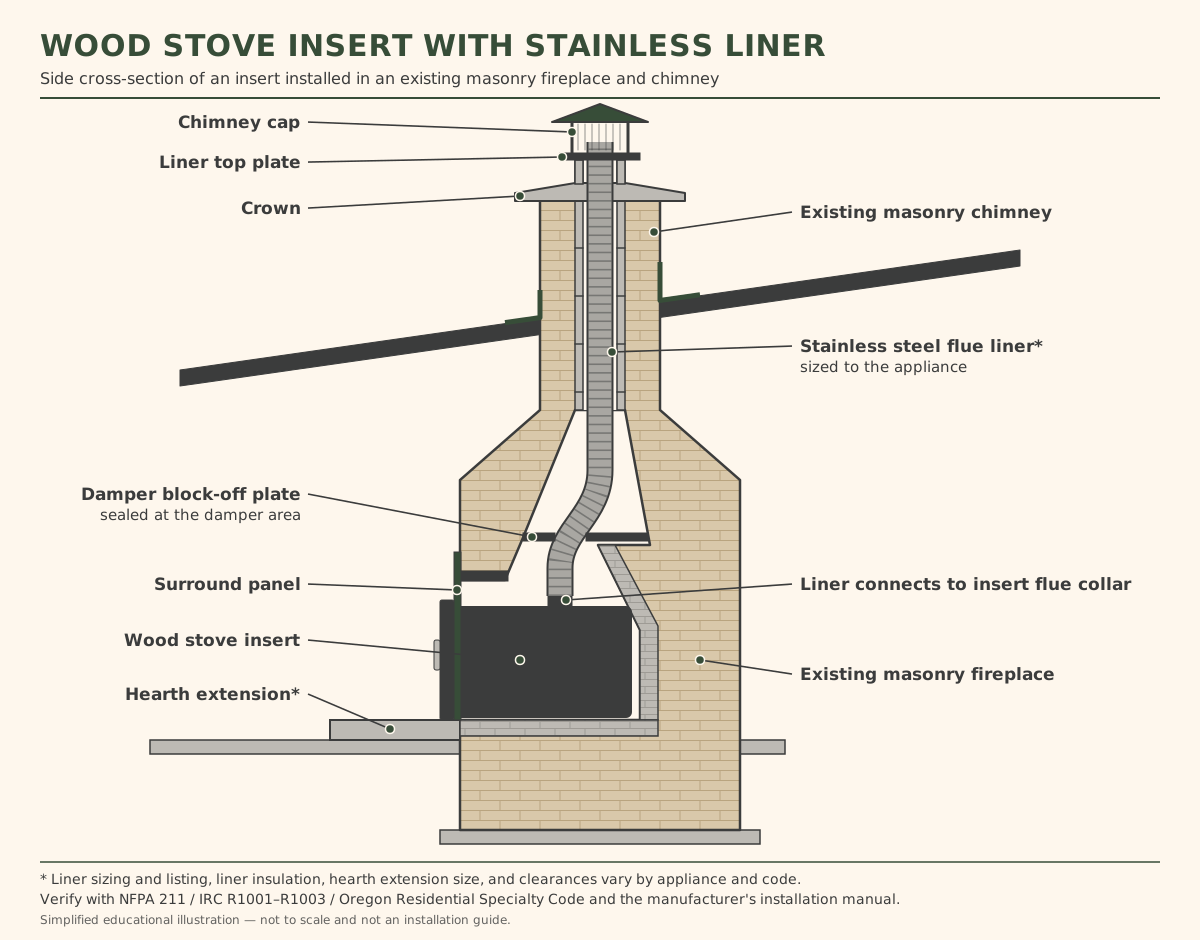
Wood Stove Insert with Stainless Liner
A wood stove insert in a masonry fireplace, connected to a stainless liner.
-
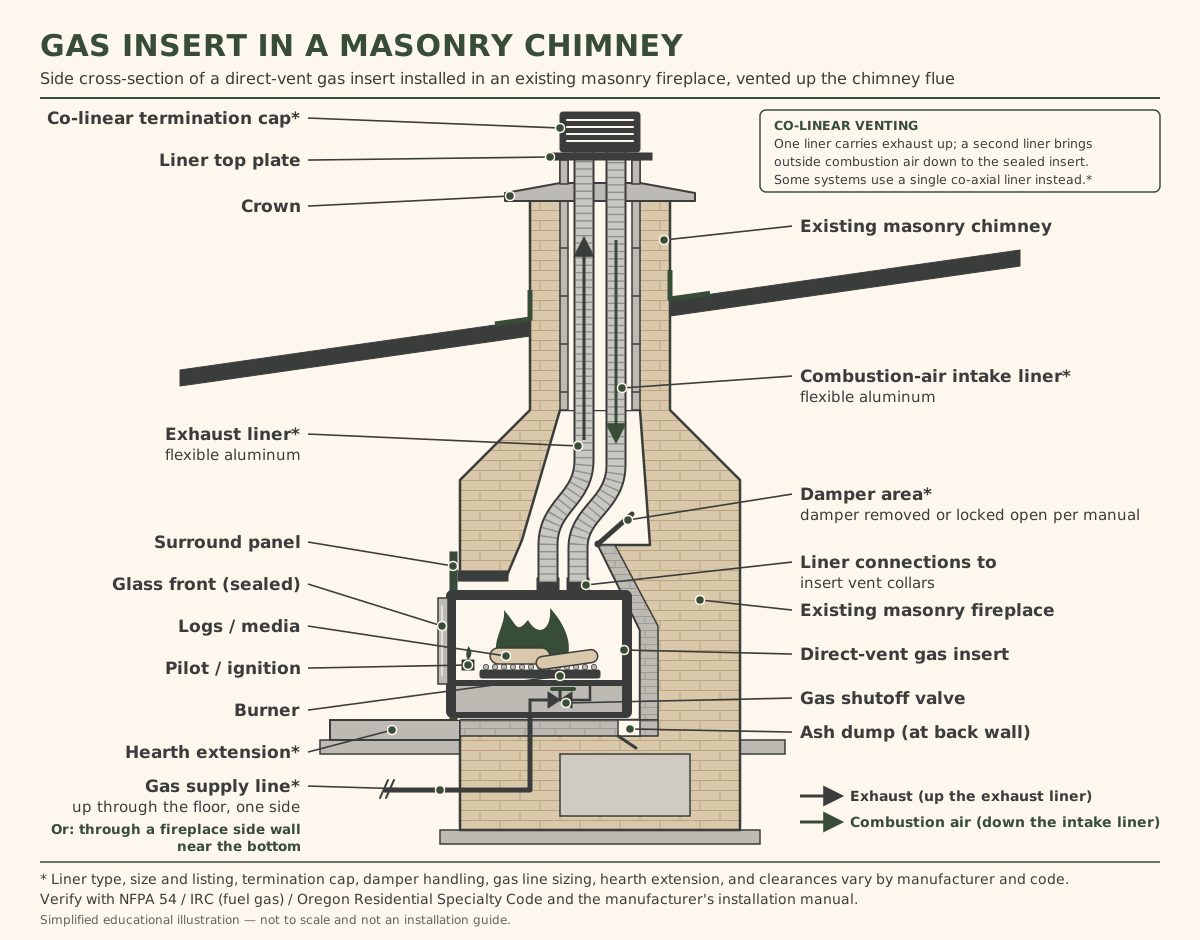
Gas Insert in a Masonry Chimney
A direct-vent gas insert vented up an existing masonry flue.
-
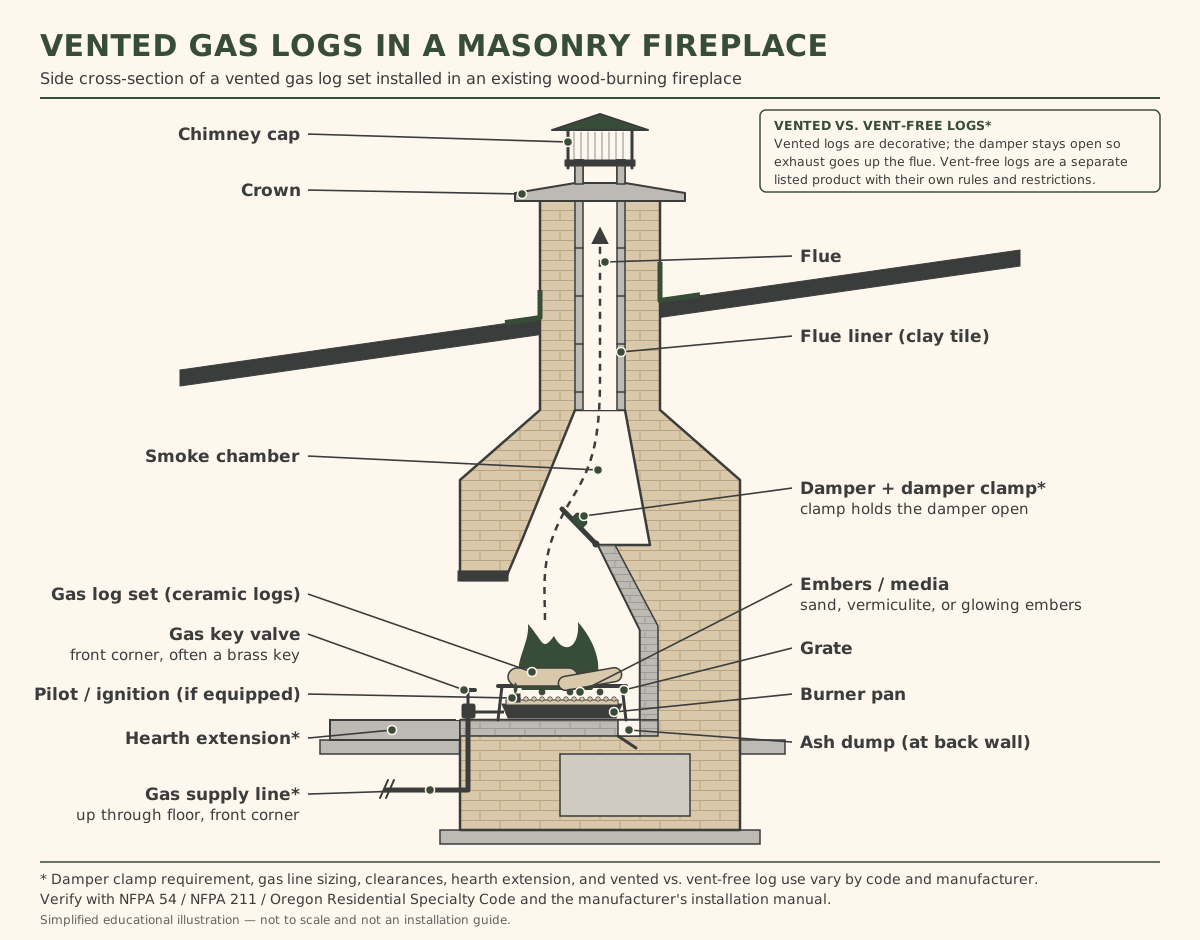
Vented Gas Logs in a Masonry Fireplace
Vented gas logs in a masonry fireplace, using the original flue.
Sources
- NFPA 211, Standard for Chimneys, Fireplaces, Vents, and Solid Fuel–Burning Appliances: section 14.2 (annual inspection for soundness, freedom from deposits, and correct clearances; cleaning, maintenance, and repairs if necessary); section 15.2 (type of inspection, including 15.2.6 on documenting an incomplete higher-level inspection); section 15.3 (Level I circumstances and scope); section 15.4, including 15.4.1 (Level II shall be conducted upon sale or transfer, and the other Level II circumstances) and 15.4.2 (scope, including accessible attics, crawl spaces, and basements; video scanning of flue interiors; clearances; lining type and size); section 15.5 (Level III, concealed areas).
- CSIA, Level 2 Inspection of a Masonry Chimney (industry standard operating procedure; describes a Level 2 inspection as recommended when a property is being sold, and requires video scanning of the chimney interior during a Level 2 inspection).
- CSIA, Homeowner Resources (quotes the NFPA 211 annual-inspection language; recommends sweeping masonry fireplaces at 1/8 inch of sooty buildup and sooner if glaze is present; factory-built fireplaces when any appreciable buildup occurs; notes that glazed or gummy creosote may need chemical treatment plus mechanical cleaning; states that chemical cleaners alone are not a substitute for inspection and mechanical cleaning; states that chimneys serving gas appliances should be inspected annually; damper safety notes).
- OAR 812-008-0210 (Oregon certified home inspectors shall observe chimneys, flues, and vents where readily visible, and solid-fuel heating devices; not required to observe the interior of flues or fireplace-insert flue connections, or to ignite or extinguish solid-fuel fires), and OAR 812-008-0204 (not required to report compliance or non-compliance with codes, ordinances, statutes, or regulatory requirements, or the methods, materials, and costs of corrections). Official compilation: Oregon Construction Contractors Board, Home Inspection Standards of Behavior and Standards of Practice.
- 2024 International Residential Code as adopted by the 2026 Oregon Residential Specialty Code (construction chapters in phase-in; the 2023 ORSC based on the 2021 IRC also remains available during that period — confirm the edition with the local building official): R903.2.2 and R1003.20 (crickets); R1001.7.1 (damper); R1001.11 and R1003.18 (clearances to combustibles); R1003.9.1 (chimney caps/crowns); R1003.9.2 (spark arrestors); R1003.9.3 (rain caps); R1003.11 and R1003.11.1 (flue lining, including ASTM C315 clay tile and UL 1777 listed systems); R1003.12 (clay flue lining installation); R1004.1 and R1005.1 (listed factory-built fireplaces and chimneys). Oregon amendment: ORS 215.730 (spark arrestor on forest-zoned land). See also the masonry code table on this site.
- NFPA 54 / ANSI Z223.1, National Fuel Gas Code, and IRC Chapter 24 (fuel gas), for installation and maintenance of gas appliances and their venting, together with the appliance manufacturer’s instructions and listing.