
A reference for homeowners and insurance agents
Chimney and wood-stove information for insurance
Chimneys, fireplaces, and wood-burning appliances are a regular part of the home fire problem in the United States. This page is for homeowners, and for insurance agents who may want a clear reference to share with clients. It explains why inspections and records matter, what NFPA 211 asks for, what documentation is useful to keep, and what questions to take to an insurance agent. It is an educational reference, not legal advice, not insurance advice, and not an offer of services. Coverage depends on the written policy, the insurer, and the facts of a loss. Confirm anything that matters with the insurance agent and the policy itself.
Why chimneys and wood stoves matter to insurers
Heating equipment is a leading cause of fires in U.S. homes. In its Home Structure Fires analysis of 2019–2023, NFPA found that heating equipment was the second leading cause of home fires, home fire injuries, and home fire deaths, and the third leading cause of direct property damage. An average of 65,000 such fires caused 430 deaths, 1,530 injuries, and $1.1 billion in direct property damage per year. Fireplace and chimney fires were a particular issue in living rooms, where most fireplaces and woodstoves are located.
NFPA’s supporting tables for home heating fires, using 2016–2020 annual averages, give a closer look at chimneys and flues. Municipal fire departments responded to an estimated 44,210 home structure fires caused by heating equipment each year. Confined chimney or flue fires — fires that began in and stayed in the chimney or flue — averaged 13,120 a year, or 30 percent of those heating-equipment fires, with relatively little reported loss in that confined category. Non-confined fireplace or chimney fires were fewer, at 3,010 a year (7 percent), but they accounted for an estimated 30 civilian deaths, 50 injuries, and $234 million in direct property damage per year, or 22 percent of the property damage from heating-equipment fires.
The U.S. Fire Administration’s estimate for a more recent single year, 2024, is 27,200 residential building heating fires, with 145 deaths, 475 injuries, and $445.9 million in dollar loss. NFPA and USFA publish related national estimates that cover different years and are not always identical, because of method and definition. The figures above are cited with their periods so they are not mixed as a single number.
A chimney fire that stays in the flue can still be a serious event for the masonry or the liner. A fire that leaves the flue can damage the house. Either way, households and insurers have a shared interest in knowing how the system was installed, whether it has been inspected and cleaned, and whether records exist if a claim is later made.
NFPA 211: annual inspection and the three levels
NFPA 211, the Standard for Chimneys, Fireplaces, Vents, and Solid Fuel–Burning Appliances, is the industry standard that describes how existing chimneys are inspected. CSIA and NFPA both point to its annual-inspection language. NFPA’s home-heating fire safety practices also include having heating equipment and chimneys inspected and cleaned every year by a qualified professional.
Section 14.2 provides that chimneys, fireplaces, and vents shall be inspected at least once a year for soundness, freedom from deposits, and correct clearances, and that cleaning, maintenance, and repairs shall be done if necessary. That is a requirement of the standard. It is not, by itself, a law that every household must follow, and it is not automatically a condition of every insurance policy. Whether a particular insurer requires proof of that work is a question for the agent, below.
-
Level I
Used to verify that the chimney or flue is suitable for continued service under the same conditions, with the same or a similar appliance. It is the level associated with the annual inspection and with routine cleaning. It covers readily accessible portions of the chimney and accessible portions of the appliance and connector. It does not, by itself, require a video scan of the entire flue.
-
Level II
Used when the chimney’s suitability for new or changed conditions of service needs to be verified, or when a Level I inspection is not sufficient. A Level II inspection shall be conducted upon sale or transfer of the property; when an appliance is added, removed, or replaced with one of a dissimilar type, input, or efficiency; prior to relining; and after a fire, weather or seismic event, or other incident likely to have caused damage. It includes the Level I items, accessible attics, crawl spaces, and basements, a video scan or other examination of flue interiors, accessible clearances, and whether the lining type and size fit the connected appliances. The sale-or-transfer provision is a requirement of the standard, not automatically a statewide legal mandate.
-
Level III
Used only for concealed areas that are suspected of malfunction or damage and that cannot be properly evaluated at Level I or Level II. It may require removal of permanently attached portions of the chimney or the building, as necessary. It is not a routine annual or listing inspection.
How policies typically treat fire, maintenance, and records
Standard homeowners policies generally cover sudden, accidental fire. In many policies that includes a fire that starts in a chimney or in a heating appliance. The written policy controls, and this page is not a promise that any particular loss will be paid.
A homeowners policy is not a maintenance contract. The National Association of Insurance Commissioners’ consumer guide puts it this way: the policy insures against damage from perils such as fire, wind, and hail; it does not pay to repair items that simply wear out; and the homeowner is responsible for the upkeep of the home, “such as repairing your roof when it begins to leak or cleaning your chimney flue so it doesn’t catch fire.” The Washington state insurance commissioner’s office, in guidance on smoke damage, similarly notes that insurance covers sudden accidents, not ongoing issues like chimney maintenance, and that the policyholder must properly maintain the home and heating systems. Sudden and accidental smoke damage is typically treated under the same coverage as fire; gradual wear is not.
Depending on your policy, a claim could be questioned, reduced, or denied if the insurer finds the damage came from neglect or lack of maintenance, and you could be left paying for repairs out of pocket. How a company draws the line between a sudden accidental fire and pre-existing deterioration — for example, flue tiles that were already cracked, or a crown that had been leaking for some time — varies by policy, by insurer, and by the facts of the loss. Missing documentation, or a wood stove or insert that was never disclosed or was installed without a required permit, can also complicate a claim or the underwriting of a policy. None of that means every unpaid-sweep situation ends in a denied claim. It does mean the policy and the records matter, and that the only reliable answer for a given household is the one from the agent and the policy itself.
Documentation that helps
Records will not change what a policy covers, but they can show what was inspected, what was installed, and when. The NAIC guide also advises keeping insurance paperwork, correspondence, and receipts for repairs. Useful chimney records typically include:
- A dated sweep or inspection report, with the level of inspection (I, II, or III) if one was performed.
- Photographs of relevant conditions, and camera or video footage of the flue interior when a Level II or Level III inspection is done.
- Permits and any inspection sign-off for a stove, an insert, a liner, or other chimney work.
- The appliance listing label and the manufacturer’s installation manual, when those exist.
- Notes on fuel used, known problems, and any prior chimney fire, weather damage, or repair.
When chimney repairs might be part of a claim
Needed repairs are not automatically a covered claim. They may be considered when the damage came from a sudden, accidental event that the policy covers. Common examples — which still depend on the written policy — include a chimney or flue fire (for example, flue tiles that are cracked or displaced after a fire in the flue), fire or lightning, windstorm or hail, and a falling object such as a tree or limb.* Earthquake damage is not usually part of a standard homeowners policy; it is generally covered only if earthquake insurance was added as an endorsement or bought as a separate policy.* Gradual deterioration, wear and tear, age, and long-term water damage from lack of maintenance are typically excluded. The insurer and the adjuster decide whether a particular loss is covered. This page does not promise that any repair will be paid.
A flue fire can go unnoticed. CSIA states that the majority of chimney fires go undetected, and that slow-burning chimney fires often are not found until a later inspection, even though they can still damage the chimney. Signs a professional may look for, according to CSIA, include “puffy” or honeycombed creosote; cracked, collapsed, or missing chunks of flue tile; warped metal on a damper, connector, or factory-built chimney; and a discolored or distorted rain cap. Those signs are observations, not by themselves a coverage decision. If they appear, the honest next step is to document what is seen and ask the agent how the policy would treat it.
If you think a covered loss may have occurred
- Read the policy and talk with the insurance agent before assuming a repair is, or is not, covered.
- Document promptly. Take dated photographs. If a camera or video inspection is done, keep a written report that records the observed condition and, where the inspector can support it, a likely cause — without overstating what cannot be known, such as the exact date of a past flue fire. CSIA recommends having damaged areas photographed before the chimney is swept, and asking for copies of inspection photos, so an adjuster can see the condition as it was found.
- Keep the report, photographs, and receipts for any temporary protection or later repair work.
- Limit further damage. The NAIC advises contacting the agent or company as soon as possible after a loss and protecting the home from further damage. CSIA advises not using the chimney until it has been swept and evaluated by a qualified professional, because joint failure, cracked tiles, or metal fatigue may not be visible from the top or the bottom alone.
- Know that deductibles and deadlines for reporting a loss vary by policy. A deductible is the amount paid out of pocket on a claim before the policy pays the rest, and it is paid on each claim. Ask the agent what the reporting period is. This page does not assign a number of days.
- The inspector documents conditions. The insurer and the adjuster decide coverage.
Report the facts honestly. An inspector can describe what was found and, when the evidence supports it, what likely caused it. No one should invent a cause, a date, or a sequence of events to make a repair look like a sudden covered loss. Oregon law provides that a fire insurance policy is void if, whether before or after a loss, the insured has willfully concealed or misrepresented a material fact, or in the case of fraud or false swearing relating to the insurance (ORS 742.208). Oregon’s Division of Financial Regulation has advised that misstatements are not fraudulent unless they are made with the intent to knowingly defraud, and that claim-form warnings may say a person “may be guilty of insurance fraud” or “may be subject to prosecution for insurance fraud.” An honest uncertainty about when damage occurred is not the same thing as misrepresenting the cause or the timing.
Things underwriters often ask about
The NAIC consumer guide lists a wood furnace or wood stove among the characteristics that can affect how insurers look at a home. Beyond that, the details below are items that commonly come up. Each is marked with an asterisk because requirements and questions vary by insurer and by policy. Confirm them with the agent rather than assuming they apply in every case.
- Whether the home has a wood stove, a fireplace insert, a pellet stove, a gas insert, or a masonry fireplace.*
- Whether the appliance is listed and labeled (for example, tested to a recognized standard such as UL).*
- Who installed it, and whether a permit was obtained and the work was inspected.*
- Clearances from the appliance, the connector, and the chimney to combustible walls, ceilings, and furnishings.*
- The hearth or floor protection under a stove, and any wall protection.*
- The chimney type: a masonry flue (and whether it is lined) or a listed factory-built chimney, often called Class A or Type HT pipe.*
- For a stove insert, whether a listed liner was installed in the existing flue.*
- When the chimney was last inspected or swept, and whether a written report exists.*
- Whether the appliance is the primary heat source or a supplemental one.*
Questions to ask your insurance agent
These questions are for a homeowner, or for an agent walking through a policy with a client. The answers are in the policy and in the company’s underwriting rules, not on this page.
- Does this policy cover a fire that starts in the chimney or flue, including a fire that stays in the flue and a fire that spreads into the house?
- Is there a wear-and-tear, deterioration, or lack-of-maintenance provision that could affect a chimney or heating-appliance claim? How would a sudden chimney fire be distinguished from pre-existing deterioration?
- Do you require proof of periodic chimney inspection or sweeping, and if so, how often and in what form?
- Do I need to disclose a wood stove, fireplace insert, pellet stove, or gas insert? Does disclosure change eligibility or the premium?
- Does an unpermitted, unlisted, or homemade stove or insert installation affect coverage, renewal, or the ability to obtain a policy?
- Is sudden smoke or soot damage from a chimney or appliance fire covered? What about gradual soot, odor, or staining that is not from a sudden accidental fire?
- After a chimney fire, how does the policy treat repair or rebuilding of the flue and chimney versus conditions that were already deteriorated, such as cracked tiles or a failed crown?
- Is water that enters through the chimney, crown, cap, or flashing covered, or is that usually treated as maintenance or wear and tear?
- What documentation do you want on file — dated inspection or sweep reports, photographs or camera footage, permits, listing labels, or manuals?
- Does a Level II inspection at purchase or sale matter for underwriting or for a later claim?
- Are there any discounts for documented inspections, or for a professionally installed and permitted stove or insert?
- If a stove, insert, or liner is added, replaced, or removed, when should that be reported to you?
- If an inspection finds damage that may have come from a past chimney fire, how would a claim be handled, and is there a time limit to report it?
- If a sudden covered event damaged the chimney — for example a flue fire, wind, lightning, a fallen tree or limb, or hail — what repairs would the policy consider, and how is the deductible applied?
Related pages on this site
The For Realtors page covers chimney inspections in a real-estate transaction, including what belongs in a useful report. The system pages below have labeled cross-sections and glossaries for the most common setups.
-
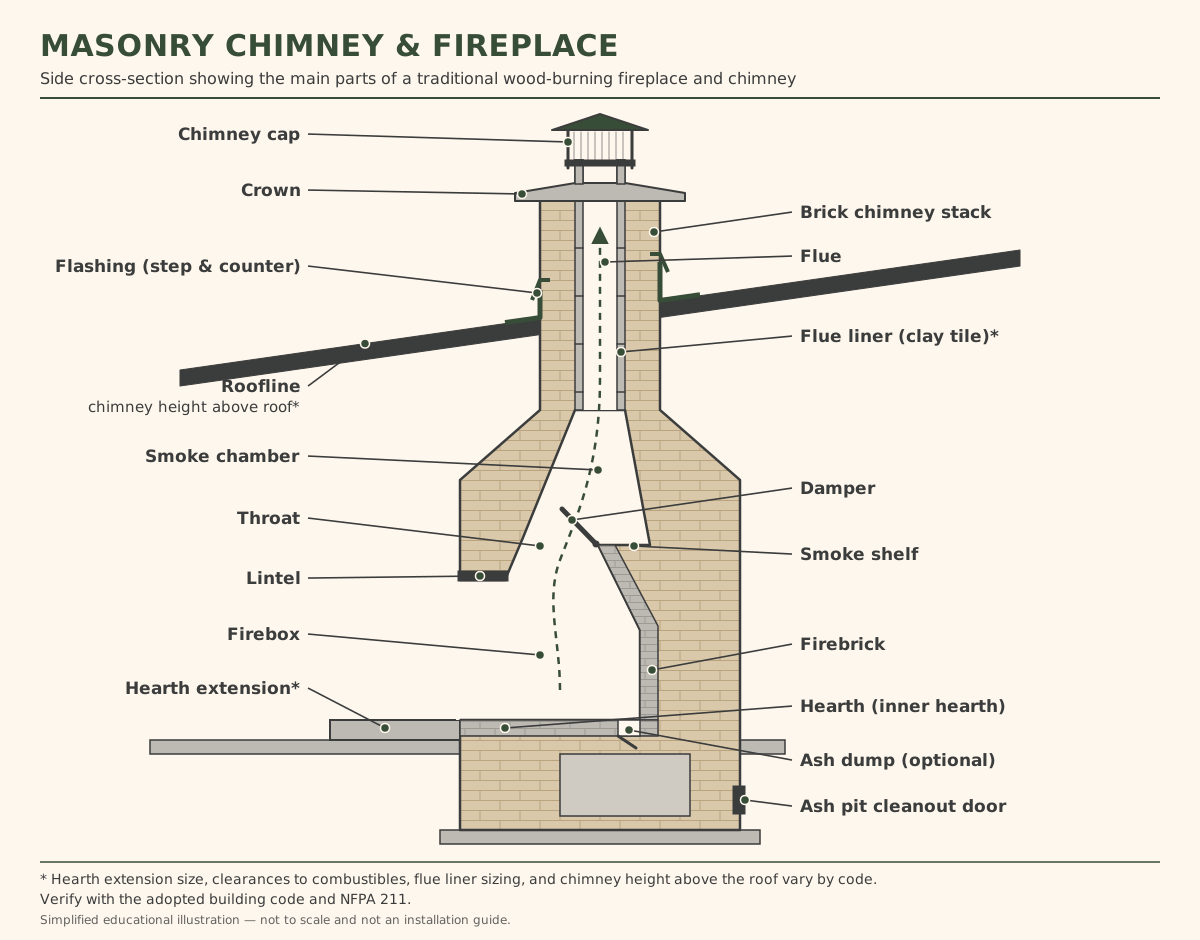
Masonry Chimney & Fireplace
A site-built wood-burning fireplace and brick chimney, shown in side cross-section.
-
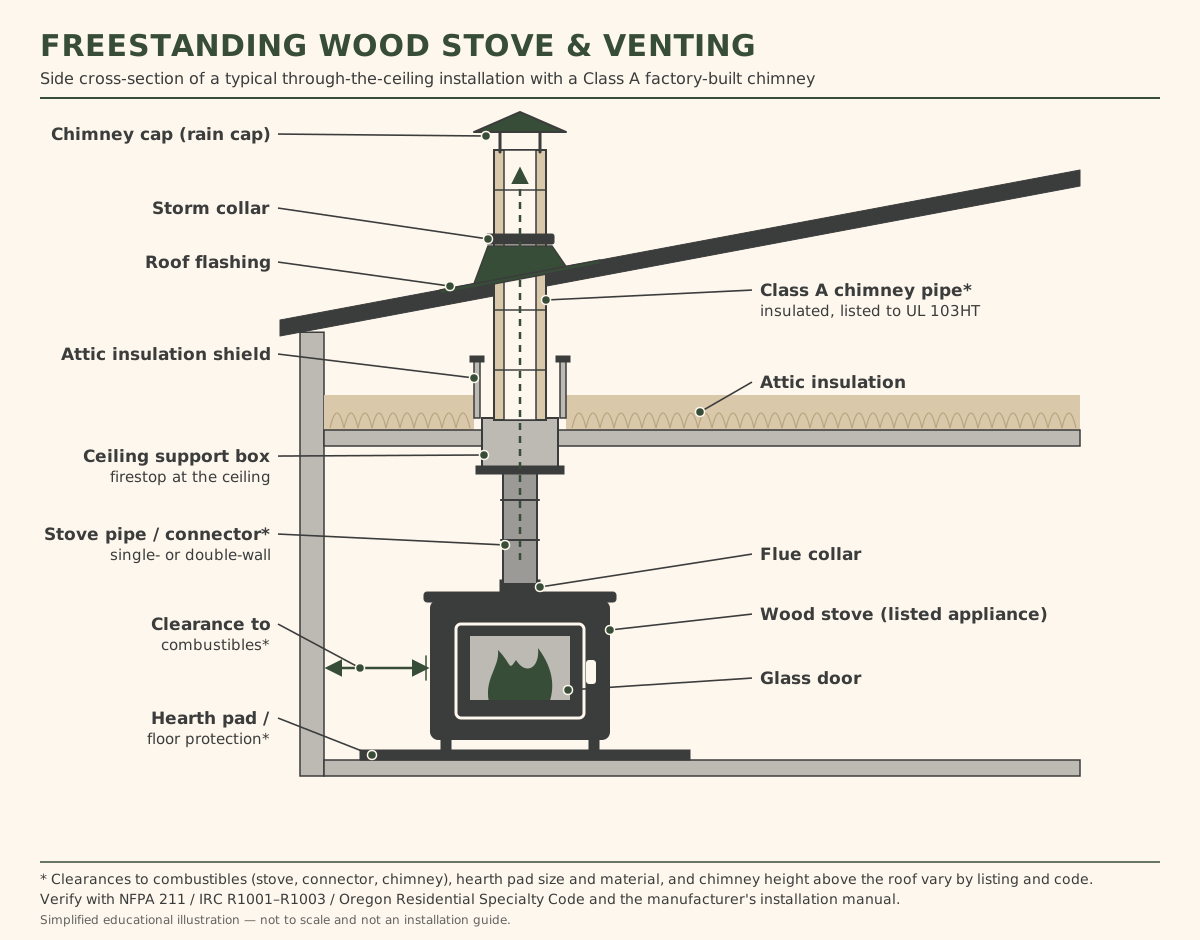
Freestanding Wood Stove & Venting
A freestanding wood stove vented through a factory-built Class A chimney.
-
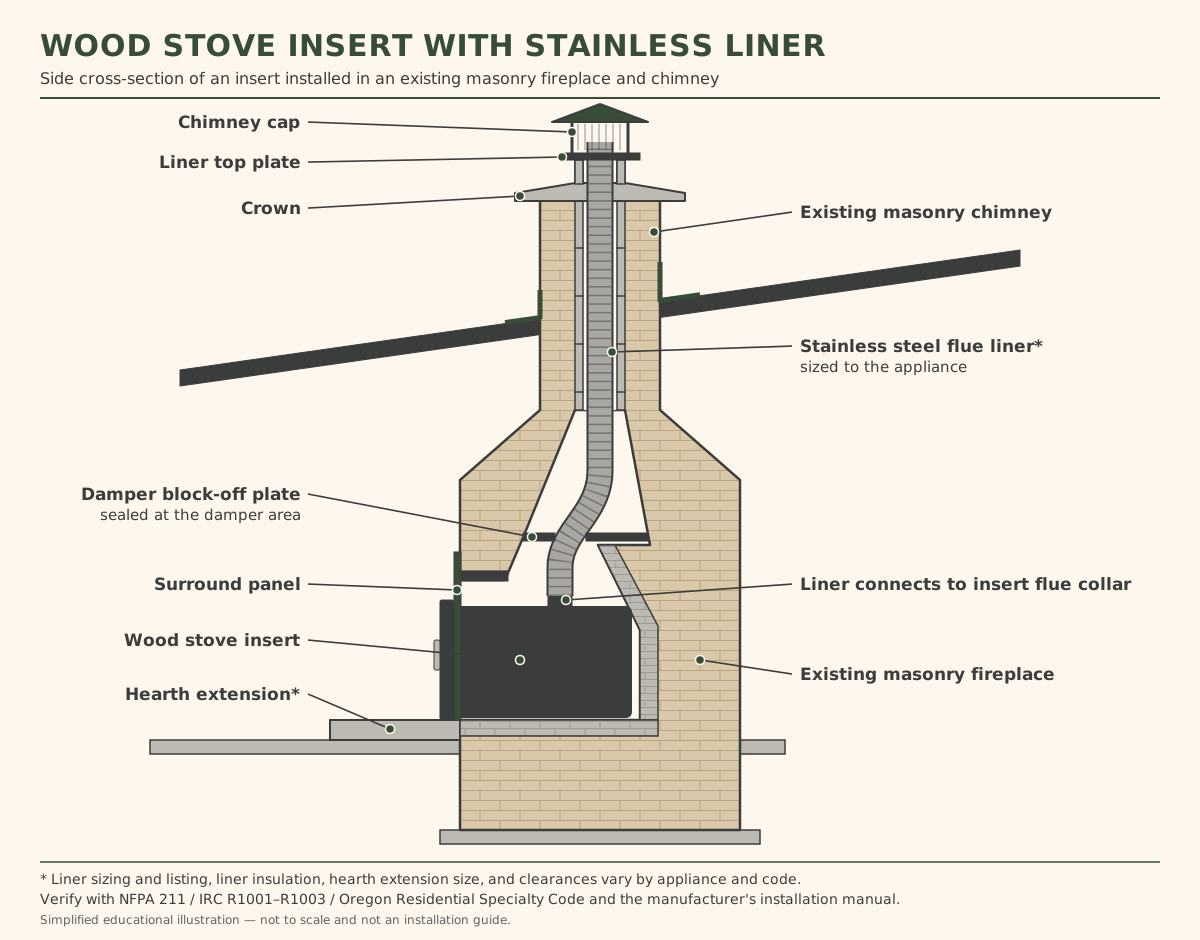
Wood Stove Insert with Stainless Liner
A wood stove insert in a masonry fireplace, connected to a stainless liner.
-
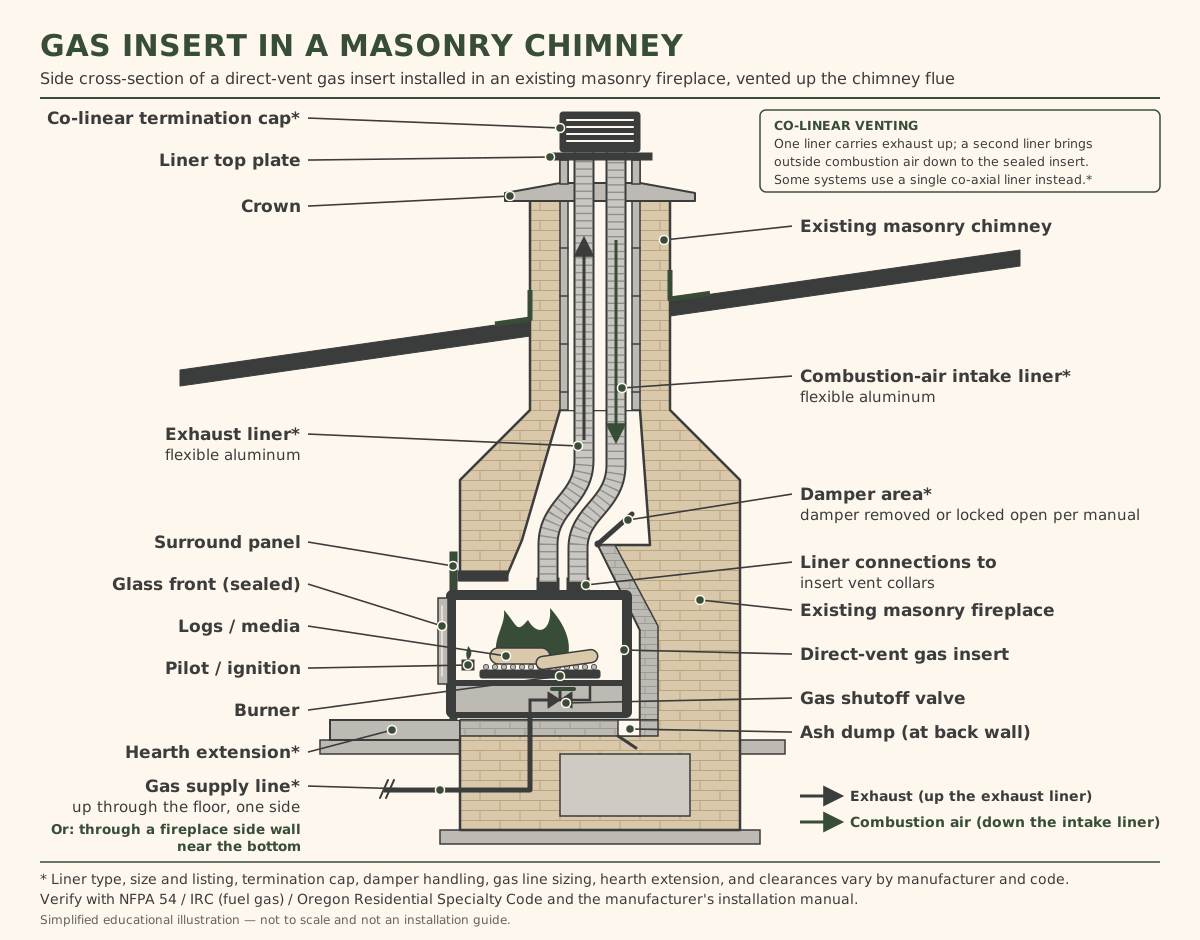
Gas Insert in a Masonry Chimney
A direct-vent gas insert vented up an existing masonry flue.
-
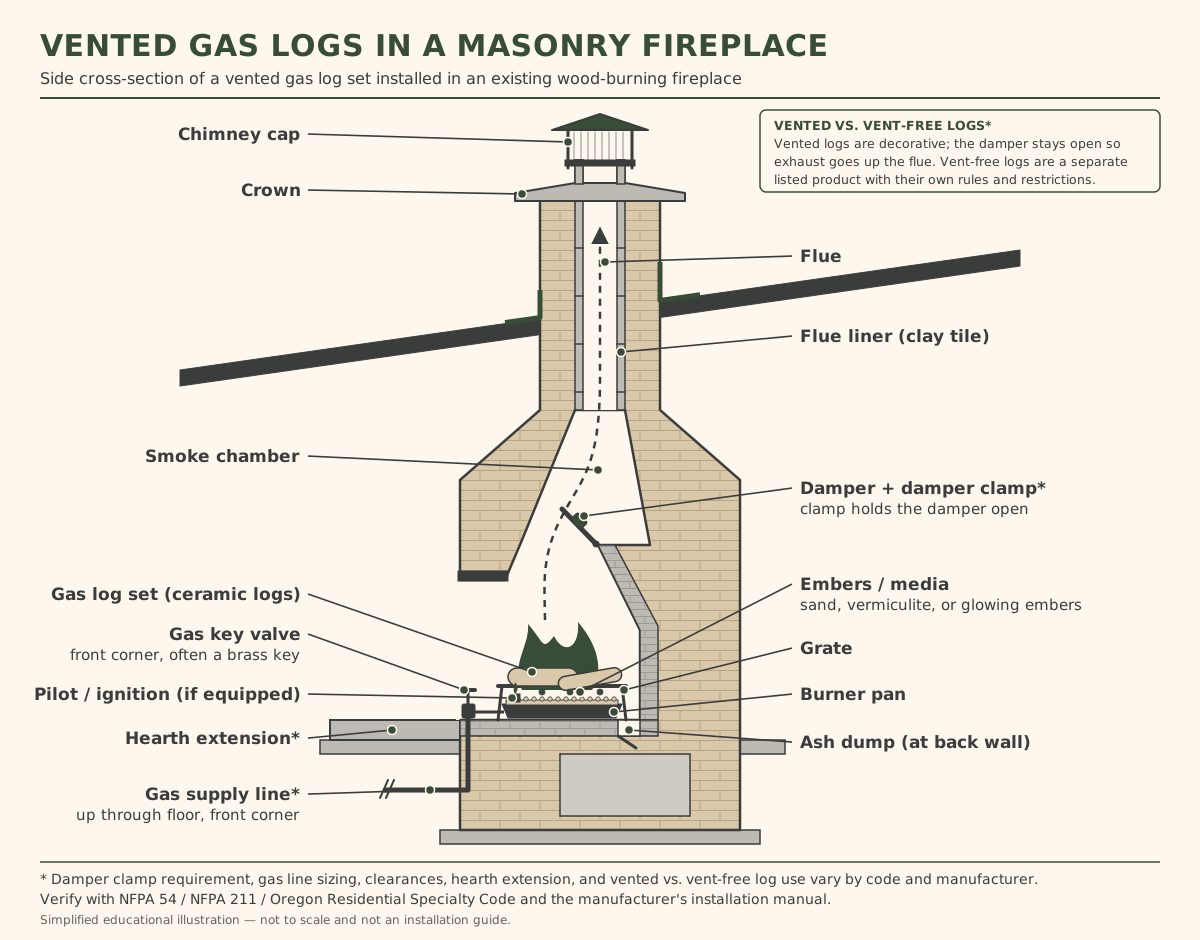
Vented Gas Logs in a Masonry Fireplace
Vented gas logs in a masonry fireplace, using the original flue.
Sources
- NFPA, Home Structure Fires (Hall and McGree, August 2025): 2019–2023 annual averages — heating equipment as the second leading cause of home fires, injuries, and deaths and the third leading cause of direct property damage; 65,000 such fires, 430 deaths, 1,530 injuries, and $1.1 billion in direct property damage per year; fireplace and chimney fires as a particular issue in living rooms.
- NFPA, Home Heating Fires (Campbell, December 2022), and the supporting tables (2016–2020 annual averages): 44,210 home heating-equipment fires per year; confined chimney or flue fires 13,120 (30 percent); non-confined fireplace or chimney fires 3,010 (7 percent), with 30 civilian deaths, 50 injuries, and $234 million in direct property damage (22 percent of heating-equipment property damage). The report’s safety practices include having heating equipment and chimneys inspected and cleaned every year by a qualified professional.
- U.S. Fire Administration, Residential building heating fire trends (2015–2024): 2024 national estimates of 27,200 residential building heating fires, 145 deaths, 475 injuries, and $445.9 million in dollar loss. Page last reviewed September 28, 2026.
- NFPA 211, Standard for Chimneys, Fireplaces, Vents, and Solid Fuel–Burning Appliances: section 14.2 (annual inspection); sections 15.3, 15.4 (including 15.4.1, Level II upon sale or transfer), and 15.5 (Levels I, II, and III).
- CSIA, Homeowner Resources (quotes the NFPA 211 annual-inspection language), and Level 2 Inspection of a Masonry Chimney.
- National Association of Insurance Commissioners, A Consumer’s Guide to Home Insurance: a homeowners policy is not a maintenance contract; it does not pay to repair items that simply wear out; the homeowner is responsible for upkeep, including “cleaning your chimney flue so it doesn’t catch fire”; a wood furnace or wood stove can be a factor in how insurers look at a home; keep insurance paperwork and receipts for repairs.
- Washington State Office of the Insurance Commissioner, Smoke damage and your homeowner or renter insurance: standard policies typically cover sudden and accidental smoke damage; wear and tear — insurance covers sudden accidents, not ongoing issues like chimney maintenance; the policyholder must properly maintain the home and heating systems. This is general consumer guidance from one state regulator, not a statement of every policy.
- CSIA, Preventing Chimney Fires: the majority of chimney fires go undetected; slow-burning chimney fires often go undetected until a later inspection; professional signs include “puffy” or honeycombed creosote, warped damper or other metal parts, cracked or collapsed flue tiles or tiles with large chunks missing, and a discolored or distorted rain cap; a chimney fire can also crack tiles and displace mortar.
- CSIA, What You need to know after a chimney fire: do not use the chimney until it has been swept and evaluated; damage such as joint failure, metal fatigue, or cracking may not be visible from above or below; photograph damaged areas before sweeping and keep inspection photos for an adjuster. (CSIA also states that most chimney-fire damage is considered a covered loss; this page does not treat that as a guarantee — coverage is decided by the insurer under the policy.)
- NAIC, A Consumer’s Guide to Home Insurance: covered-peril examples include fire, wind, and hail; contact the agent or company as soon as possible after a loss and protect the home from further damage; a deductible is the amount paid out of pocket on a claim before the policy pays, and it is paid on each claim.
- NAIC, A Consumer’s Guide to Earthquake Insurance: standard homeowners, renters, or condominium policies do not cover earthquake damage; earthquake coverage is added by endorsement or bought as a separate policy.
- Insurance Information Institute, Which disasters are covered by homeowners insurance?: fire or lightning, and windstorm or hail, are named perils on standard policy forms; falling object is a named peril on many forms (including typical HO-2 and HO-3 policies) but not all; earthquake is not typically covered unless added as a separate policy or endorsement; damage due to lack of maintenance is not covered.
- Oregon Revised Statutes 742.208 (concealment, fraud, and representations by the insured on a fire insurance policy): the policy is void if, whether before or after a loss, the insured has willfully concealed or misrepresented a material fact, or in the case of fraud or false swearing relating to the insurance.
- Oregon Division of Financial Regulation, Bulletin INS 2010-03 (fraud or misstatement warnings): misstatements, misrepresentations, omissions, or concealments are not fraudulent unless they are made with intent to knowingly defraud; acceptable warning language includes that a person “may be guilty of insurance fraud” or “may be subject to prosecution for insurance fraud.” For fire insurance, material misrepresentations must be willful or intentional (ORS 742.208).